
Quick answer: The best privacy-first Google Analytics alternatives in 2026, Plausible, Fathom, Simple Analytics, Pirsch, Umami, and UseClick, all skip cookies and personal-data collection by design rather than adding a consent banner on top of tracking. They differ mainly in hosting location, pricing model, and whether analytics is bundled with other tools like link tracking and bio pages, or sold as a standalone product.
Key Takeaways
- "Cookie-free" means the tool doesn't need a consent banner in the first place, not a workaround for showing one.
- Plausible and Fathom are purpose-built, standalone analytics tools with the deepest dedicated feature sets.
- Simple Analytics, Pirsch, and Umami each offer variations on the same privacy-first model, including self-hosted and open-source options.
- UseClick pairs cookie-free web analytics with link tracking and bio-page analytics in one dashboard, which is a real trade-off, not a strict upgrade: you're choosing integration over depth in any single category.
- None of these tools store IP addresses or use persistent cross-site identifiers, which is what actually determines GDPR/ePrivacy exposure.
Why Look for a Google Analytics Alternative in 2026?
The most common trigger isn't ideology, it's the consent banner. Google Analytics relies on cookies and, depending on configuration, can involve data transfers that require a documented legal basis under GDPR. That means a cookie consent banner, a rejection flow that has to actually work, and ongoing risk if your configuration drifts out of compliance. Teams switch when they'd rather not manage that risk, or when a banner is measurably hurting conversion on landing pages.
To be fair to Google Analytics: it's free, deeply integrated with Google Ads, and has by far the largest ecosystem of tutorials, agencies, and integrations. If your team already has GA4 configured correctly with consent mode and isn't looking to simplify, switching isn't automatically the right call. The tools below solve a specific problem (compliance overhead, banner friction, data minimization), not a universal one. For a side-by-side view of what you gain and give up, see UseClick vs Google Analytics.
What Does "Cookieless" or "No Cookies" Analytics Actually Mean?
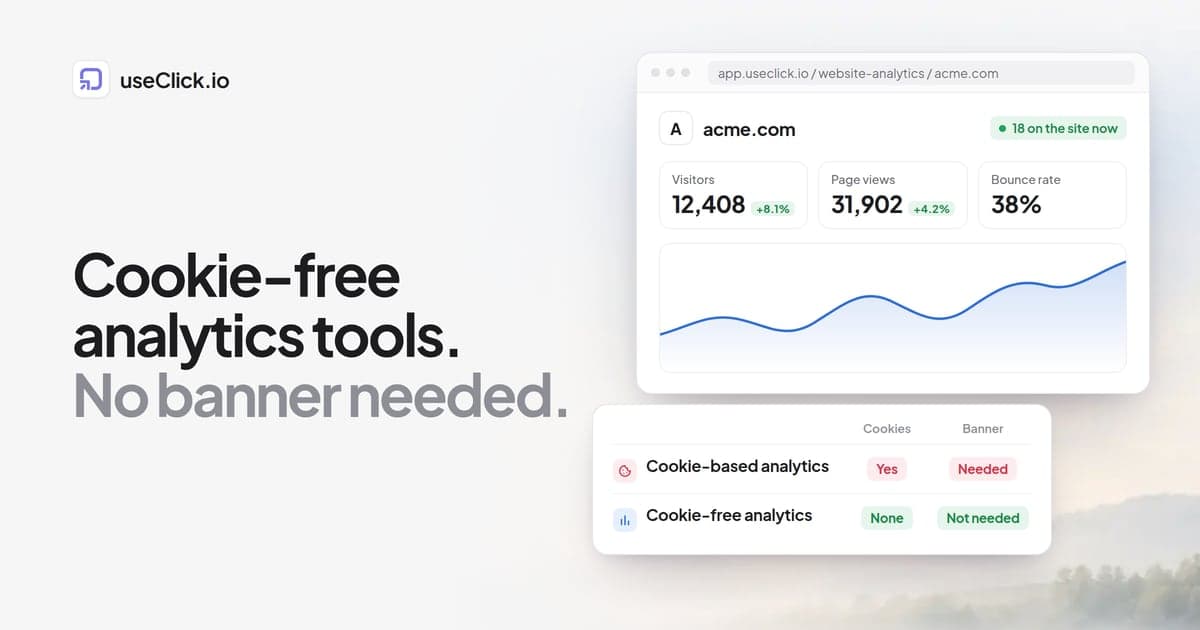
It means the tool counts visits and events without setting a cookie or storing a persistent, personally identifying value in the browser. In practice, most privacy-first analytics tools use one of two approaches: a daily-rotating hash built from the visitor's IP and user agent (discarded, never stored) to deduplicate unique visitors, or no visitor-level identification at all, just aggregate counts. Combined with never storing raw IP addresses and keeping location coarse (country, region or city, never GPS), this is what lets these tools operate under GDPR's data minimization principle (Article 5(1)(c)) without needing consent for tracking. See GDPR-compliant link tracking for the same principle applied to click data specifically.
Best Google Analytics Alternatives Compared
| Tool | Model | Self-hosting | Starting price | Notable |
|---|---|---|---|---|
| Plausible | Cloud or self-hosted (Community Edition) | Yes | ~$15/month (100K pageviews) | Widely used, mature ecosystem, self-hosting for full data ownership |
| Fathom | Cloud, EU data isolation available | No | Higher entry tier, weekly email reports | Strong for teams that want EU isolation without self-hosting |
| Simple Analytics | Cloud | No | Comparable entry tier | Minimalist dashboard, EU-hosted |
| Pirsch | Cloud or self-hosted | Yes | Free tier available | Open-source, generous free allowance |
| Umami | Self-hosted (open-source) or cloud | Yes | Free (self-hosted) | Fully open-source, requires your own hosting for the free option |
| UseClick | Cloud | No | $12/month | Bundles web analytics with link tracking and link-in-bio analytics in one dashboard |
Which Alternative Also Covers Link Tracking and Link-in-Bio, Not Just Web Analytics?
This is the honest trade-off worth naming directly: Plausible, Fathom, Simple Analytics, and Umami are purpose-built web analytics tools, and that focus shows in deeper dashboard customization, more mature integrations, and (for Umami and Pirsch) real self-hosting options if data residency requirements demand it. None of them do link shortening or link-in-bio pages; if you need those, you're running a second and third tool alongside your analytics platform.
UseClick takes the opposite bet: one privacy-first tracking layer across website analytics, short links, QR codes, and bio pages, so a click from an Instagram bio, a QR code on packaging, and a direct site visit all report through the same cookie-free system instead of three disconnected ones. That's a real advantage if you're already juggling separate tools for links and analytics, and a real disadvantage if what you actually want is the single deepest possible web-analytics product and nothing else. If that's the priority, Plausible or Fathom are the better fit (compare them directly: UseClick vs Plausible, UseClick vs Fathom).
Do You Still Need a Consent Banner If You Switch?
Generally, no. That's the point of tools in this category. If the analytics tool doesn't set cookies, doesn't store IP addresses, and doesn't build cross-site or persistent visitor profiles, it typically falls outside the scope of activity that requires cookie consent under the EU's ePrivacy rules. That said, "generally" is doing real work in that sentence: always check the specific tool's data practices (does it store any raw IP, even temporarily? does it use any third-party script that itself sets cookies?) rather than assuming category membership guarantees compliance. Self-hosted options like Umami put that verification fully in your own hands, for better or worse.
Frequently Asked Questions
What is the most GDPR-compliant Google Analytics alternative?
Any tool in this category that avoids cookies, doesn't store IP addresses, and keeps location coarse (country, region or city, never GPS) is operating on the same data-minimization principle GDPR requires. The differentiator between them is less about "which is most compliant" and more about hosting location (EU-based or self-hosted vs. US-based cloud) and how transparently each documents its data practices.
Do privacy-first analytics tools require a cookie consent banner?
No, typically not. That's the design goal. A consent banner is required for cookie-based or persistent-identifier tracking; tools that use aggregate, cookie-free counting generally don't trigger that requirement. Verify the specific tool's documentation rather than assuming it by category.
What's the best free Google Analytics alternative?
Pirsch and Umami both offer free tiers. Umami's free option requires self-hosting, while Pirsch offers a free hosted tier with usage limits. Both are open-source if you want to inspect exactly what's collected.
Which Google Analytics alternative is hosted in the EU?
Fathom offers EU data isolation as an option, and Simple Analytics is EU-based by default. Self-hosted options (Umami, Pirsch, Plausible Community Edition) let you choose your own hosting region entirely.
Can you track link clicks and website analytics in one tool?
Yes. UseClick combines cookie-free website analytics with short-link and link-in-bio click tracking in a single dashboard. Standalone analytics tools like Plausible and Fathom are web-analytics-only and don't include link shortening or bio pages.
Is Plausible or Fathom better for GDPR compliance?
Both are built on the same cookie-free, no-IP-storage foundation, so neither has a structural compliance advantage over the other. The practical difference is usually hosting preference (Plausible supports self-hosting; Fathom offers EU data isolation without self-hosting) rather than the underlying privacy model.
What data does cookieless analytics actually collect?
Typically: page views, referrer/traffic source, browser and device category, and coarse location (country, often region and city), aggregated, without a persistent visitor identifier. What it generally does not collect: IP addresses, GPS or street-level location, full user-agent strings, or any cross-site identifier.