
Quick answer: Check which AI crawlers can access your site with a free AI crawlability checker. It tests your
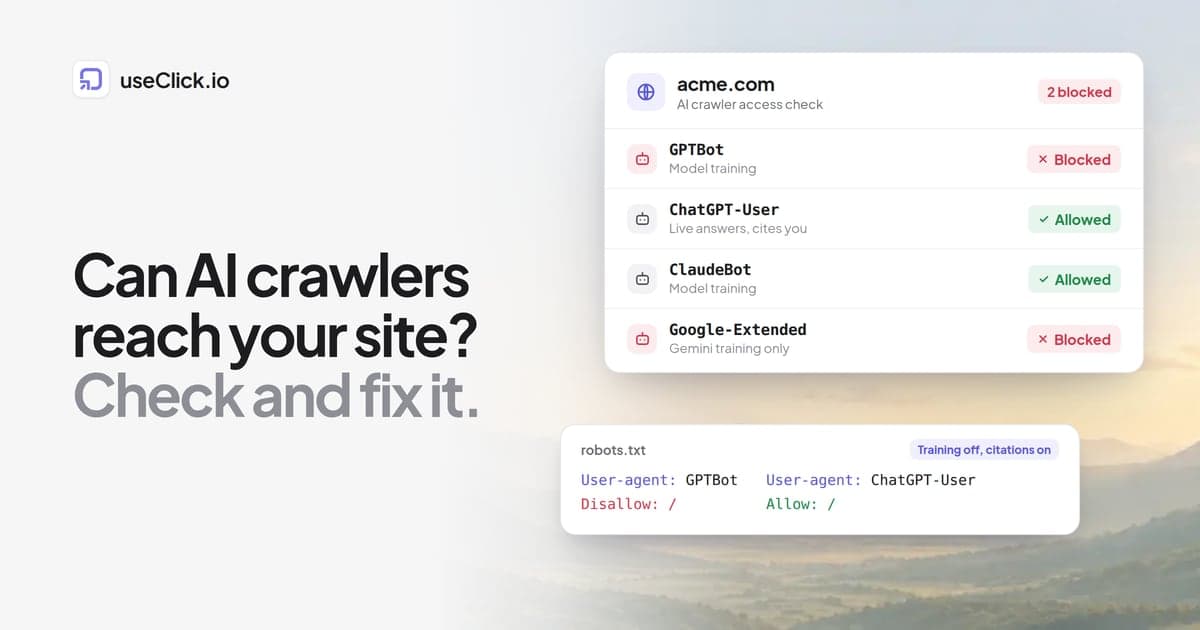
robots.txtagainst GPTBot, ClaudeBot, PerplexityBot, and other named AI user agents, and flags accessibility issues (missing structured data, weak heading structure, thin content) that affect whether AI answer engines can actually cite your pages. Blocking a training crawler (likeGPTBotorGoogle-Extended) is a deliberate choice; it doesn't affect whether ChatGPT or Google can still cite your content via their separate real-time browsing crawlers.
Key Takeaways
- AI crawlers fall into two categories: training crawlers (build a model) and browsing crawlers (fetch a page in response to a live query). Blocking one doesn't block the other.
Google-Extendedcontrols Gemini training only. It has no effect on Google Search indexing or AI Overviews, which use the regularGooglebot.GPTBotcontrols OpenAI's model training only. Blocking it doesn't stopChatGPT-Userfrom browsing and citing your page in a live ChatGPT answer.- Being crawlable isn't the same as being citable: structured data, clear headings, and direct-answer formatting matter more than robots.txt access once a crawler can reach your page.
- A misconfigured wildcard rule (
Disallow: /underUser-agent: *) can accidentally block every crawler, human-facing search included.
Which AI Crawlers Actually Matter Right Now?
| Crawler | Company | robots.txt token | What it does |
|---|---|---|---|
| GPTBot | OpenAI | GPTBot |
Crawls for model training |
| ChatGPT-User | OpenAI | ChatGPT-User |
Fetches a page in real time when ChatGPT browses on a user's behalf |
| ClaudeBot | Anthropic | ClaudeBot |
Crawls for model training |
| PerplexityBot | Perplexity | PerplexityBot |
Crawls for both its search index and training |
| Google-Extended | Google-Extended |
Controls Gemini training use, separate from Googlebot | |
| Bytespider | ByteDance | Bytespider |
Crawls for model training |
| CCBot | Common Crawl | CCBot |
Feeds the open Common Crawl dataset, which many AI labs train on |
The distinction that trips people up most: training access and citation access are controlled separately. Blocking GPTBot stops OpenAI from using your content to train future models. It does not stop ChatGPT-User from fetching your page live when someone asks ChatGPT a question and it browses the web for an answer. Same logic applies to Google-Extended and Googlebot. If your goal is "don't train on my content but still let AI engines cite me," you need to block the training-specific token and explicitly allow the browsing one.
How Do You Check Which Crawlers Can Access Your Site?
Run your domain through a robots.txt checker or an AI crawlability checker to see, line by line, which named user agents are allowed or disallowed. The most common mistake isn't an intentional AI-blocking rule. It's an old, overly broad Disallow rule written before AI crawlers existed, sitting under User-agent: *, which silently blocks all of them (and often hurts regular search crawling too).
A minimal, deliberate setup looks like this:
# Block AI training crawlers, allow browsing crawlers and search
User-agent: GPTBot
Disallow: /

User-agent: Google-Extended
Disallow: /

User-agent: Bytespider
Disallow: /

User-agent: *
Allow: /
Note what this does and doesn't do: it stops those three crawlers from training on your content, while leaving ChatGPT-User, PerplexityBot, ClaudeBot, Googlebot, and every other crawler with default access under the wildcard rule.
Should You Block AI Crawlers at All?
That depends on what you're optimizing for. If ChatGPT, Perplexity, or Google's AI Overviews are already sending you referral traffic (a growing number of sites report this), blocking the crawlers that power those citations directly cuts off that channel. Roughly 3-5% of sites currently use AI-specific robots.txt rules, which means most site owners haven't made a deliberate choice either way; they're running whatever robots.txt they had before AI crawlers existed.
The reasonable default for most content sites: allow AI crawlers to access your public content, both training and browsing, because being cited by an AI engine is a distribution channel, not a threat, in the same way being indexed by Google is. The exception is content genuinely intended to stay off training datasets (proprietary data, gated content, anything where reproduction risk outweighs the visibility benefit).
Does Allowing Crawlers Guarantee You'll Get Cited?
No. Crawl access is necessary but not sufficient. Once a crawler can reach your page, whether an AI engine actually cites it depends on the same things that make content useful to a human skimming for an answer: a direct answer near the top of the page (not buried after three paragraphs of preamble), clear question-format headings, structured data that makes entities and facts machine-parseable, and content that says something a summary of ten other pages wouldn't already say. Fixing robots.txt access solves the access problem. Whether an AI engine would actually quote this specific page is a content and structure question, not a crawling one.
Frequently Asked Questions
How do I check if GPTBot can access my site?
Run your domain through a robots.txt checker or AI crawlability checker. Both parse your live robots.txt and tell you explicitly whether GPTBot, ClaudeBot, PerplexityBot, and other named AI crawlers are allowed or blocked.
Does blocking Google-Extended stop my site from appearing in Google Search?
No. Google-Extended controls whether Google can use your content for Gemini model training. It has no effect on regular Google Search indexing or AI Overviews, which are governed by Googlebot, a separate crawler.
Does blocking GPTBot stop ChatGPT from citing my page?
No. GPTBot is OpenAI's training crawler. ChatGPT-User is a separate crawler that fetches pages in real time when ChatGPT browses the web to answer a question. Blocking GPTBot prevents training use; it doesn't block ChatGPT-User from citing your content live unless you block that token too.
What's the most common robots.txt mistake that blocks AI crawlers by accident?
An old, overly broad Disallow: / rule under User-agent: *, written before AI crawlers existed, which ends up blocking every crawler, AI and traditional search alike, without anyone intending it to.
Should I block AI crawlers to protect my content?
Only if you're prepared to also lose the citation and referral traffic that comes from being included in AI-generated answers. For most public content, allowing crawl access is closer to allowing search indexing than it is to a security risk. It's a distribution channel, not an exposure.
Is being crawlable the same as being cited by ChatGPT or Google AI Overviews?
No. Crawl access only means an AI engine's crawler can reach your page. Whether it actually gets cited depends on content structure: direct answers, clear headings, structured data, and genuinely new information, not just whether the crawler was let in.